Lovable recently threw open their doors for a free AI weekend to flex their new model integrations.
Naturally, I did what any reasonable person would do: built three wildly different apps using the exact same prompt to see which AI would emerge victorious in this digital thunderdome.
These are three random ideas that popped into my head the Friday before Lovable unleashed the chaos:
-> a petrol price finder,
-> a product analytics platform for sales teams,
-> and a webapp that tells you how world news will personally ruin your day.
Spoiler alert: my favourite LLM provider is the best.
The apps
You ready?
1) The Fuel Finder (video)
If you own a car or have the misfortune of paying for petrol in someone else's, you know this pain intimately.
You've just filled your tank, feeling somewhat accomplished, only to drive past another station flaunting prices that are 10p cheaper.
It's the automotive equivalent of buying something full price and then seeing it on sale the next day.
Is this trivial in our current economic hellscape? Absolutely.
Does it still sting? Every. Single. Time.
GasBuddy is an app available in the US, but we don't have an equivalent in the UK. So I decided to change that, and FuelFinder was born.
(Fun fact: All three LLM providers independently named the app "FuelFinder" despite zero prompting about names. Either they're telepathically linked or just tragically predictable.)
The prompt
As a driver, I am always looking for the cheapest petrol station near me. Write a webapp that shows on a map petrol stations near me with their latest up to date price, and a way for users to crowd sources prices either by uploading photos or adding the price manually. Also think about this from other perspectives and what other features would be beneficial for users
Anthropic v OpenAI
Claude, my usual go-to AI buddy, decided to phone this one in. No map, nothing clickable, basically digital cardboard masquerading as an app. I considered giving it another chance with more detailed prompting, but thought I'd let the other contenders embarrass themselves first.
OpenAI actually showed up to the party. It integrated Mapbox (impressive!), though this did require me to sign up for yet another service and endure some prompting back-and-forth. The app also had a brief existential crisis with an infinite refresh loop, but eventually pulled itself together with some decent synthetic data.
OpenAI takes the early lead.
OpenAI v Google
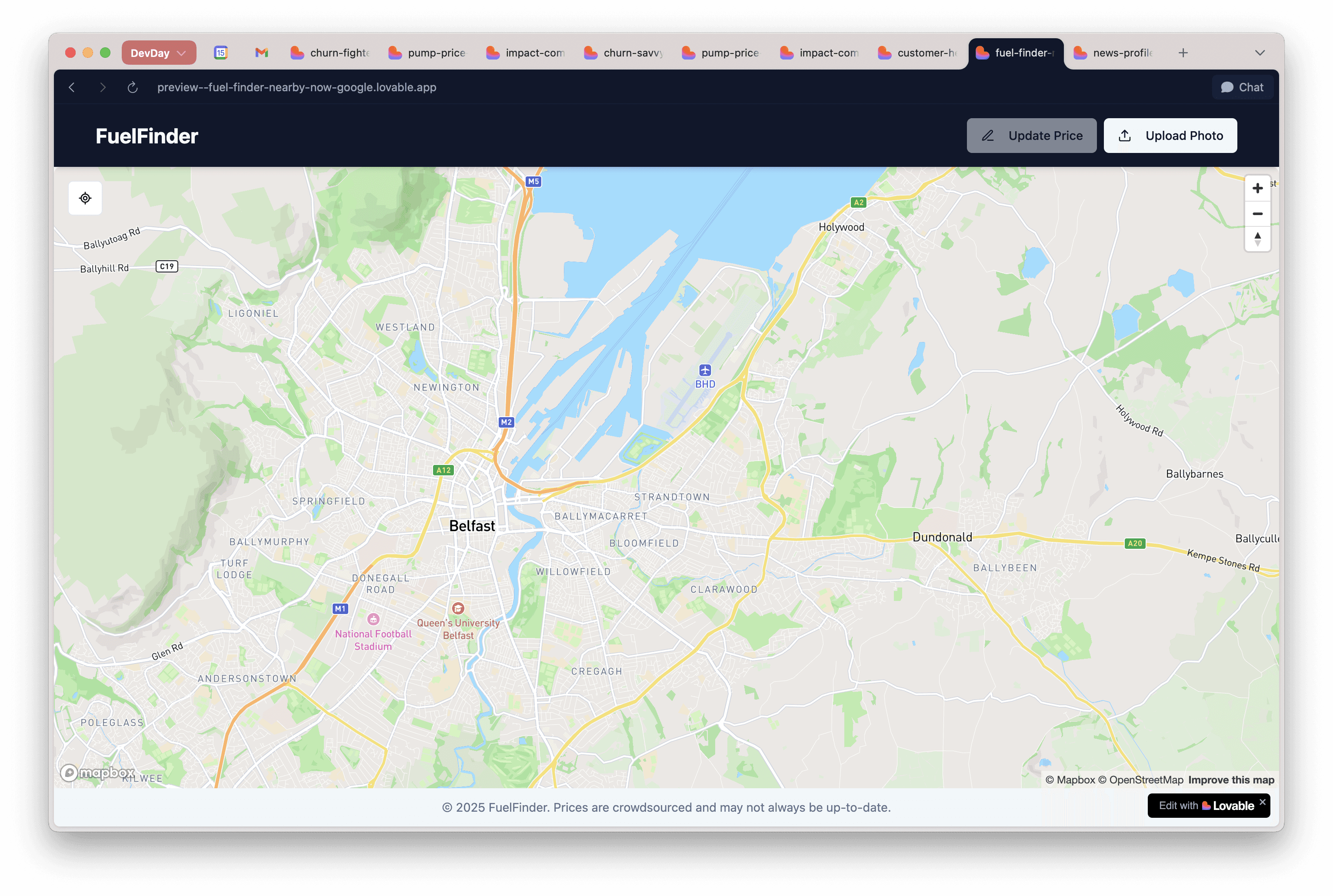
Google also went the Mapbox route, points for consistency! But... where are the actual petrol stations? We've got a price update button that exists in a beautiful state of quantum uncertainty, simultaneously there and not there, clickable yet unclickable.
Thanks for nothing, Google.
Winner: OpenAI (by process of elimination)
2) Product Analytics for Sales Teams (video)
I was fortunate enough to work at one of the top observability companies as a Product Manager, where I developed a serious addiction to product analytics. But I never had time to actually dig into the data and act on insights regularly.
I left shortly after GPT-3.5 dropped, so I missed the chance to interrogate data using natural language (like some kind of data whisperer).
But now we live in an age where your sales team should be able to spot churning customers without enduring the painful ritual of data translation handoffs with Product, or Marketing.
Learning from my vague prompt failures, I enlisted Claude to help craft a more structured prompt for Lovable. (Is this cheating? Probably. Do I care? Absolutely not.)
The prompt
Product Analytics for Sales Teams - App Specification
Objective: Build a real-time product analytics platform that translates user behavior signals into actionable sales intelligence, specifically identifying friction points that indicate churn risk.
Core Functionality:
Behavioral Signal Detection: Track and analyze cart abandonment patterns, session duration drops, feature adoption stagnation, and support ticket frequency
Churn Risk Scoring: ML-based scoring engine that correlates behavioral patterns with historical churn data
Sales Alert System: Real-time notifications to sales reps when accounts exhibit high-risk behaviors
Customer Journey Mapping: Visual timeline showing user engagement trajectory with friction point annotations
Technical Requirements:
Data Integration: REST APIs for connecting e-commerce platforms (Shopify, WooCommerce), product analytics tools (Mixpanel, Amplitude), and CRM systems (Salesforce, HubSpot)
Real-time Processing: Event streaming architecture for sub-minute alert delivery
Dashboard Interface: React-based web app with role-based access (sales reps, managers, admins)
Mobile Responsiveness: Progressive web app capabilities for mobile sales teams
Key Metrics & Visualizations: Cart abandonment rate trends with contextual data (time of day, product category, user segment) Customer health scores with contributing factor breakdowns Predictive churn probability with confidence intervals ROI tracking for sales interventions triggered by platform alerts
Integration Points: Webhook support for bi-directional CRM sync, Slack/Teams notifications, and email automation platforms.
Build with scalable architecture supporting 10K+ monthly active users and 100K+ tracked events daily.
Google v OpenAI
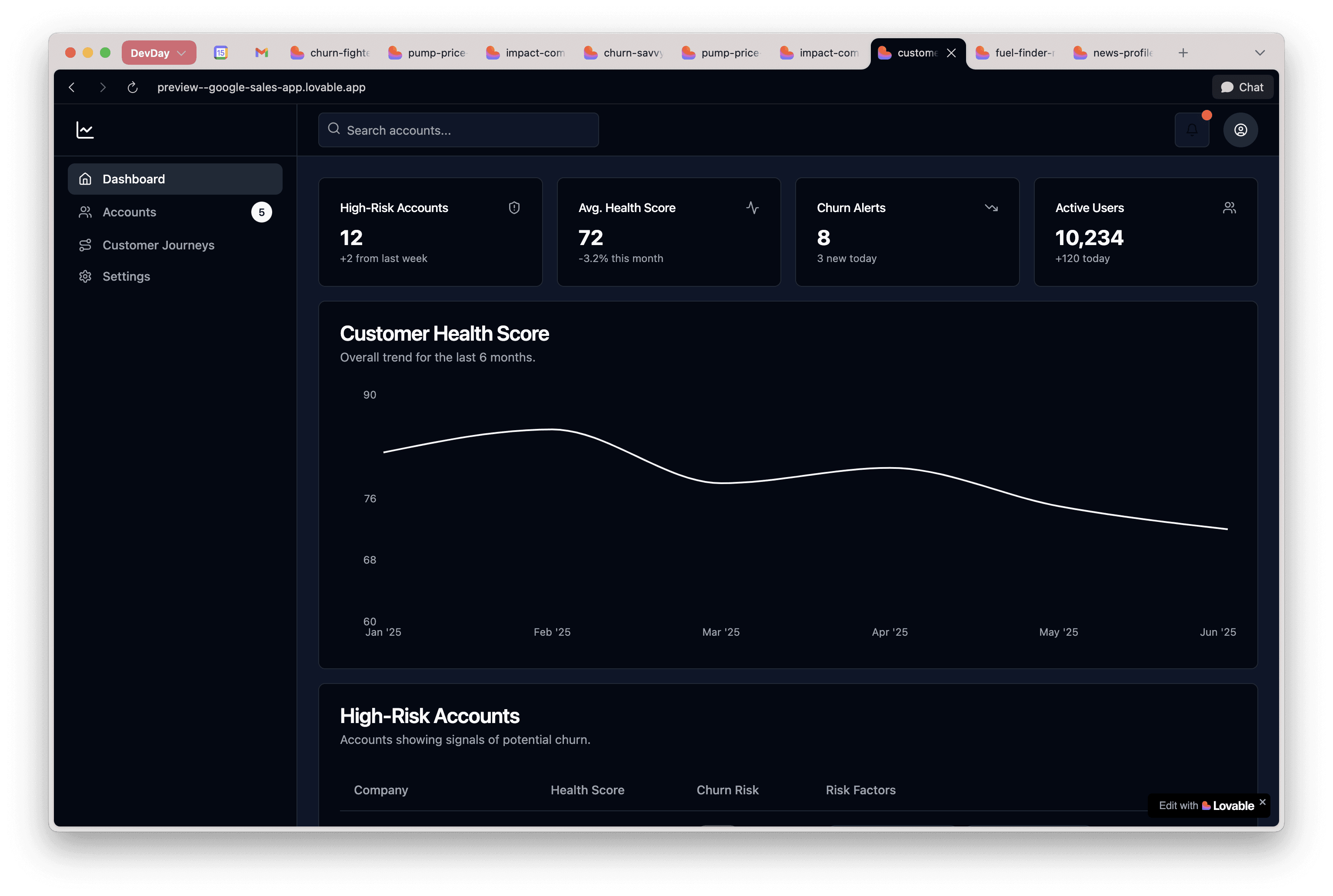
With the newly extended prompt, and given the relative success of the first app, I thought Google would shine here. But even with a dark mode settings, the app lacked any interactivity to dig into the mock data it displayed.
The graph visualisation is appealing, but I wasn't sure where to even begin with this — although my own vague prompt likely didn't help.
OpenAI delivered marginal improvements: you could actually click into synthetic customer health data and configure integrations.
Progress, I suppose.
OpenAI v Anthropic
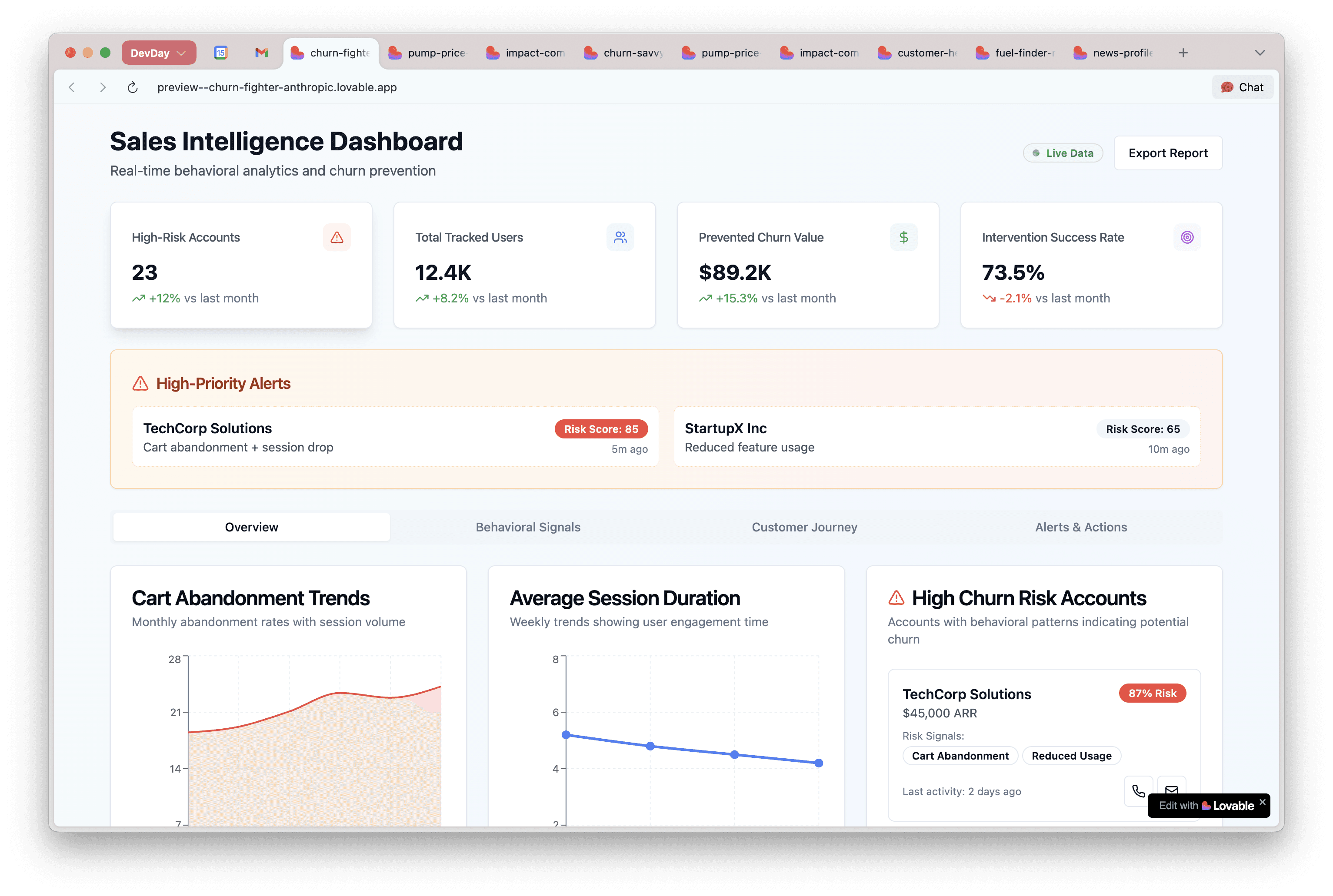
Claude came roaring back like a redemption arc in a sports movie. The dashboard was so comprehensive it looked nearly production-ready: behavioral breakdowns, customer journey mapping, alert systems, AND a monetary business impact score. This wasn't just an app; this was a sales team's fever dream made manifest.
Winner: Anthropic 🎉 (The comeback king)
3) News That Impacts Me App (video)
I genuinely try to stay informed. I subscribe to Morning Brew, The Daily Carnage, DealBook, The Deep Tech Dispatch... and I'm flipping exhausted. No sane human has enough morning coffee time to absorb industry news, global events, local updates, AND niche interests without developing an anxiety disorder.
Enter this final app: a personal news impact analyser that takes your demographic profile and tells you exactly how the world's chaos will affect your wallet and wellbeing. It's not perfect science, but it's a refreshingly honest starting point.
The prompt
Personalized News Impact Analyzer - App Specification
Objective: Build an intelligent news analysis platform that translates global and local events into personalized financial and lifestyle impacts based on user demographics, location, and consumption patterns.
Core Functionality:
User Profiling Engine: Dynamic questionnaire capturing location, age, income bracket, housing status (rent/own/renovating), shopping preferences (online/offline), dietary habits (organic/conventional), investment portfolio, and employment sector
Data Enrichment: LinkedIn API integration for professional background, spending pattern analysis via linked bank accounts (Plaid), and social media activity parsing for lifestyle indicators
News Impact Correlation: ML engine that maps news events to personal impact categories (housing costs, food prices, job market, investment effects, supply chain disruptions)
Predictive Impact Scoring: Algorithm assessing probability and magnitude of personal effects with timeline predictions
Technical Requirements: News Aggregation: Real-time feeds from Reuters, AP, local news APIs, financial data providers (Alpha Vantage), and government economic indicators
NLP Processing: Entity extraction, sentiment analysis, and event classification using transformer models
Geographic Intelligence: ZIP code-level economic data integration and regional impact modeling
Data Security: SOC2 compliance for financial data handling, encrypted user profiles, GDPR/CCPA compliance
Key Features & Outputs:
Impact Dashboard: Personalized feed showing relevant news with impact probability scores and timeline estimates
Cost Calculators: Dynamic price impact estimators for user-specific scenarios (e.g., "Ukraine conflict increases your renovation costs by 15-25% over next 6 months")
Proactive Alerts: SMS/email notifications for high-impact events affecting user's profile Trend Analysis: Historical correlation tracking between events and actual user-experienced impacts
Integration Points: LinkedIn OAuth, Plaid banking APIs, Google Maps for location services, push notification services, and calendar integration for timing-sensitive alerts.
User Experience: Progressive disclosure interface starting with basic impacts, drilling down to detailed analysis and actionable recommendations.
Build with microservices architecture supporting real-time news processing and personalized analysis for 50K+ concurrent users.
Anthropic v Google
Google made some... interesting assumptions.
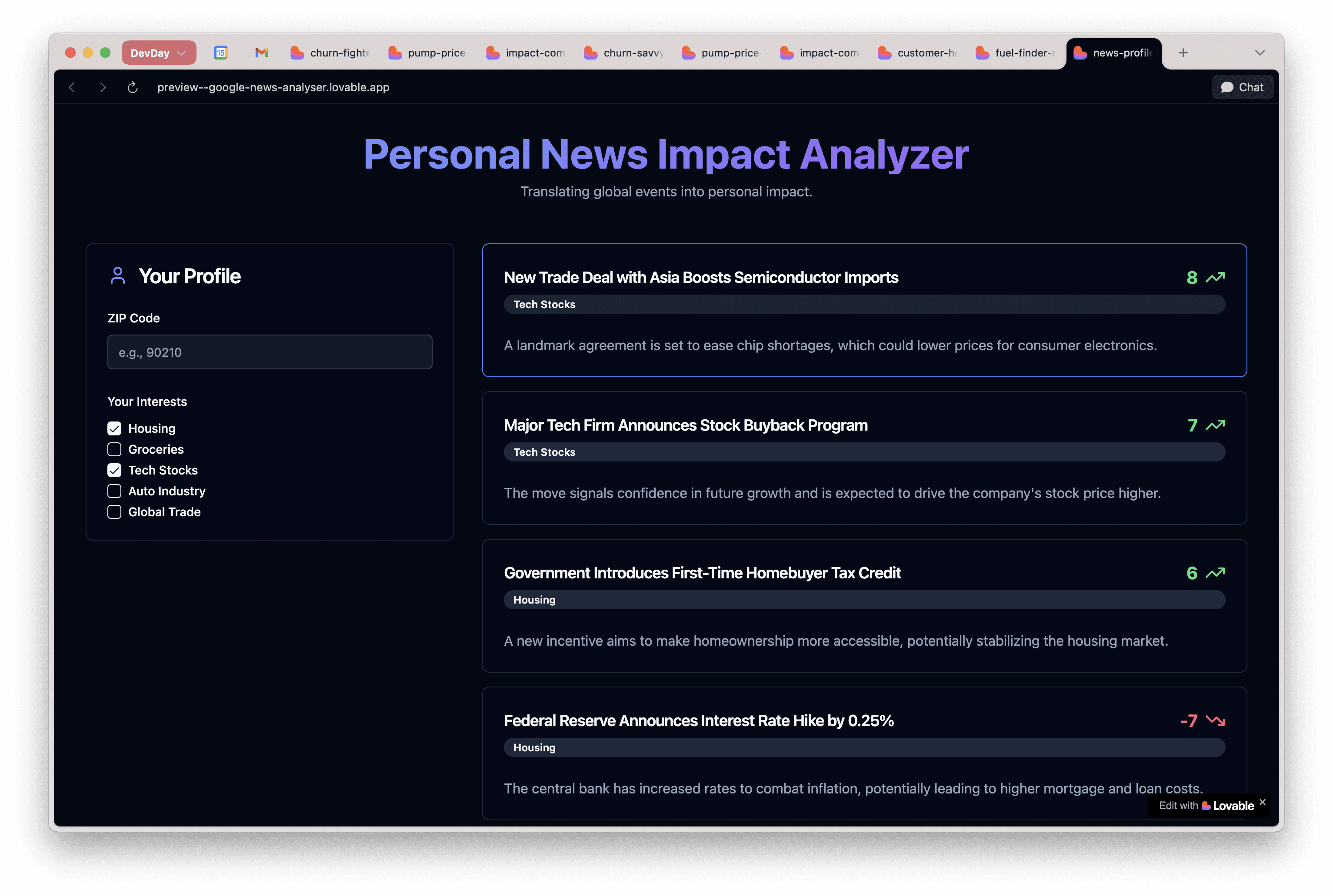
The app displayed mysterious scores like "-7" with zero context.
Is that good? Bad?
Are interest rates falling? Is my happiness declining?
Your guess is as good as mine. No settings to configure, no way to customise anything. Pretty interface, completely useless functionality.
Anthropic absolutely obliterated the competition. Full setup flow, personalised impact scores, upcoming events to watch, AND links to actual relevant articles.
Anthropic v OpenAI
Folks.
I have never reached this level of disappointment with an LLM.
I get minimalist is in, and sure, don't advertise features you haven't built yet. But when I have to wrestle with my coding assistant to build basic functionality, we've got problems.
OpenAI, you're eliminated from this competition and my future considerations.
Winner: Anthropic (By knockout)